
Play Triple Diamond Now!
Home → Strategy
Triple Diamond Strategy
Approaching Triple Diamond sensibly
The theoretical RTP of 95.06% for Triple Diamond by IGT indicates a house edge of 4.94% over extended play sessions. This specific percentage serves as the baseline for long-term expectations, distinguishing it from Wolf Run which offers an RTP of 94.98%. Players should recognize that this slight difference in return does not guarantee short-term profits but defines the mathematical boundary of the game.
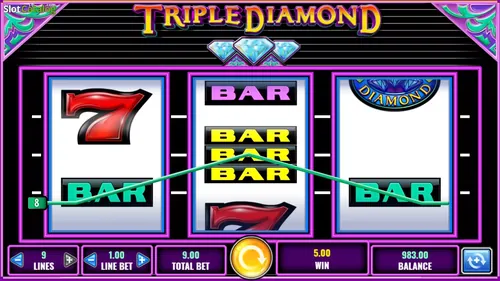
Triple Diamond features a classic 3x3 reel layout with 9 paylines and low volatility, meaning wins occur frequently but are typically smaller in size. The maximum win cap stands at 1199x the stake, providing a clear upper limit for potential payouts during any single session or streak. This structural design ensures steady engagement without the extreme swings associated with higher volatility titles found in other slot collections.
The absence of bonus rounds or free spins means every spin relies on the base game mechanics where wild multipliers can reach up to 9x. Unlike Wolf Run which may offer different feature sets, Triple Diamond focuses on consistent symbol matching with the Triple Diamond wild substituting for all symbols. This simplicity requires players to manage their bankroll strictly since there are no secondary games to extend playtime.
Bankroll rules that hold up
A dedicated bankroll must cover the cost of thousands of spins to absorb the variance inherent in low volatility slots like Triple Diamond by IGT. With a house edge of 4.94%, even small stakes will eventually erode funds if played indefinitely without strict limits or stop-loss triggers. Setting aside money specifically for this title prevents cross-contamination with other gaming activities and ensures disciplined financial management throughout the session.
Flat betting strategies work best here because progressive staking methods only accelerate the time to ruin without altering the built-in 4.94% house edge. Since Triple Diamond lacks complex bonus features, consistent wagering allows players to better track their performance against the 95.06% RTP expectation. This approach minimizes emotional decision-making and keeps the gameplay aligned with the mathematical reality of the slot's design parameters.
The maximum win potential of 1199x provides a target for session goals, yet relying on this outcome is statistically improbable in short timeframes. Comparing this to Wolf Run's 1000x max win shows similar high-value caps, but Triple Diamond's lower volatility means these peaks are less frequent. Players should view such large multipliers as rare events rather than expected outcomes when planning their overall gambling budget and exit strategies.
Bet sizing against volatility
Low volatility in Triple Diamond suggests that moderate bet sizes can sustain longer playing sessions compared to high-variance games with identical RTP percentages. The 95.06% return rate implies that smaller wagers will deplete slower, allowing more opportunities to hit the triple diamond wild combinations for multipliers. Adjusting stake levels based on remaining balance helps maintain control while maximizing the number of spins attempted within a fixed budget window.
Wild multipliers reaching up to 9x significantly impact payout structures, making precise bet sizing crucial for capitalizing on winning combinations effectively. Since the game uses a simple 3x3 reel layout, larger bets do not unlock additional features but simply scale the potential reward linearly. This linear relationship encourages conservative betting to preserve bankroll integrity while still participating in the multiplier events that define the slot's appeal.
Comparing Triple Diamond to Wolf Run highlights how volatility differences affect optimal bet sizing despite both being IGT productions with similar RTP profiles. Wolf Run's medium volatility might require smaller relative stakes to withstand dry spells, whereas Triple Diamond's low volatility allows for slightly higher frequency of returns. Understanding these nuances helps players select appropriate bet levels that align with their risk tolerance and desired session duration.
Session limits worth setting
Setting a time limit for playing Triple Diamond helps prevent fatigue-induced errors, especially given the repetitive nature of its classic 3x3 reel layout mechanics. With a house edge of 4.94%, prolonged sessions inevitably lead to losses unless strict boundaries are enforced by the player themselves. Establishing a fixed duration ensures that the experience remains controlled and does not escalate into problematic gambling behavior due to the slow bleed of funds.
Financial loss limits should be calculated based on the total bankroll divided by the expected number of spins before hitting significant variance thresholds. Since Triple Diamond offers a maximum win of 1199x, chasing this figure often leads to exceeding initial deposit amounts quickly without guaranteed success. Defining a hard stop-loss point protects the majority of the bankroll and ensures that any winnings secured remain intact after the session concludes.
Win goals provide a necessary exit strategy, particularly when approaching the 95.06% RTP over a limited number of spins where luck plays a major role. Unlike Wolf Run which may have different payout distributions, Triple Diamond's consistent low volatility means steady gains are possible but rarely substantial enough to justify continuing play. Cashing out once a reasonable profit margin is achieved preserves capital and acknowledges the random nature of each individual spin outcome.
Why chasing losses fails
Chasing losses in Triple Diamond is mathematically futile because the 4.94% house edge remains constant regardless of previous spin outcomes or stake adjustments. Increasing bets after losses does not change the underlying probability of hitting the triple diamond wild or achieving the 9x multiplier on subsequent spins. This fallacy ignores the independence of each event and assumes a corrective mechanism that simply does not exist in a game with 95.06% RTP.
The low volatility characteristic of Triple Diamond creates an illusion of frequent wins that can mask the gradual erosion of the bankroll over time. Players may feel compelled to increase stakes to recover deficits, but this action only accelerates the depletion of funds toward the inevitable statistical mean. Recognizing that each spin is independent helps break the cycle of trying to force a result that the 1199x max win cannot guarantee.
Comparing the futility of chase tactics to Wolf Run demonstrates that no slot game offers a reliable method to overcome the built-in casino advantage through betting patterns. While Wolf Run has a slightly different RTP of 94.98%, the principle remains identical: increasing bets after losses never alters the long-term negative expectation. Accepting losses as part of the entertainment cost is the only sustainable approach when engaging with games like Triple Diamond.
Triple Diamond: key facts
| Parameter | Value |
|---|---|
| Game | Triple Diamond |
| Studio | IGT |
| RTP | 95.06% |
| House edge | 4.94% |
| Volatility | low |
| Max win | 1199x |
| Reels | 3 |
| Paylines / ways | 9 |
Common systems and their limits
Triple Diamond by IGT offers a maximum win of 1199x, which sets the absolute ceiling for any payout strategy employed during mobile play sessions. This cap is significantly lower than the potential returns found in White Orchid, an IGT title featuring a larger 5x4 grid that allows for more complex symbol combinations across its reels. Players relying on progressive staking systems will find this limit restrictive because losses accumulate faster than wins can recover them under such conditions. The mathematical expectation remains negative regardless of bet size adjustments made between spins.
The house edge of 4.94% dictates that every €100 wagered statistically returns only €95.06 to players over millions of spins, making long-term profitability impossible through system betting alone. Unlike White Orchid with its 95.03% RTP, Triple Diamond’s slightly higher theoretical return does not compensate for the lack of bonus rounds or free spin features that could temporarily offset this deficit. Mobile users must accept that variance is low, meaning payouts are frequent but small, rarely reaching the high multipliers seen in other volatile slot games available today.
White Orchid provides medium volatility compared to the low volatility of Triple Diamond, resulting in less frequent but potentially larger wins that might appeal to different risk profiles on mobile devices. However, the absence of wild multipliers exceeding 9x in White Orchid means Triple Diamond retains a unique advantage for players seeking consistent multiplier hits during base gameplay. A flat betting strategy ensures bankroll longevity despite the fixed maximum win cap, whereas aggressive progression often leads to rapid depletion before hitting any significant payout threshold.
Flat betting requires placing the same stake amount on every single spin, ensuring that the player’s exposure to the 4.94% house edge remains constant throughout the entire gaming session. This approach contrasts sharply with progressive staking methods that increase bets after losses, as flat betting preserves capital longer when facing the low volatility characteristic of Triple Diamond by IGT. For example, betting €1 per spin results in a predictable loss rate of approximately €0.0494 per spin based on the theoretical return percentage provided in the game specifications.
Using a fixed stake prevents the emotional tilt that often accompanies chasing losses, which is particularly important given the game’s simple three-reel layout and lack of complex bonus features. While White Orchid offers a different experience with its 5x4 grid, the principle of flat betting applies universally to maintain control over the bankroll regardless of the specific slot mechanics involved. A player wagering €200 daily using this method would statistically lose €9.88 per day, allowing for extended entertainment value without risking total financial ruin during short mobile sessions.
The maximum win of 1199x represents the highest possible payout from a single winning combination, meaning even successful streaks cannot override the fundamental mathematical disadvantage inherent in all casino slots. By sticking to flat betting, players avoid the trap of believing that larger bets increase the probability of hitting this cap, as the odds remain identical regardless of stake size. This disciplined approach aligns well with the game’s design, which favors steady engagement over high-risk gambling strategies that often fail to produce sustainable results on mobile platforms.
Progressive staking involves raising the bet size after each loss, a strategy that mathematically accelerates the depletion of the bankroll rather than recovering previous deficits against the 4.94% house edge. In Triple Diamond, where the maximum win is capped at 1199x, no betting system can overcome the built-in advantage held by the casino, making such approaches fundamentally flawed for long-term play. This behavior stands in stark contrast to White Orchid, where medium volatility might allow for different recovery patterns, though the underlying house edge remains an insurmountable barrier for any staking plan.
The low volatility of Triple Diamond means that losing streaks are shorter but more frequent, creating a psychological pressure to increase stakes quickly to recoup minor losses before they compound. Unlike games with high volatility that offer rare but massive payouts, the consistent small wins in this slot do not provide the buffer needed to sustain progressive betting schemes effectively. A player attempting to double their bet after every loss will likely hit the table limit or exhaust their funds long before achieving a win large enough to cover the accumulated deficit.
Mobile play exacerbates these risks due to the ease of rapid spinning, which can lead to unintended rapid escalation of stakes if the player lacks strict discipline. The absence of bonus rounds or free spins in Triple Diamond removes any temporary relief from the negative expectation, forcing players to rely solely on base game multipliers up to 9x. This structural limitation ensures that progressive staking fails to alter the expected value, confirming that the house edge remains unchanged regardless of how aggressively the player adjusts their wagers.
The theoretical return to player (RTP) of 95.06% indicates that for every €100 wagered, the game statistically pays back €95.06 over an infinite number of spins, leaving a 4.94% house edge. This figure is slightly higher than the 95.03% RTP found in White Orchid, suggesting a marginally better long-term expectation for Triple Diamond players, though the difference is negligible in practice. Understanding this metric is crucial for mobile users who may mistake short-term wins for skill-based advantages, ignoring the deterministic nature of the slot’s algorithmic design.
With only nine paylines and a classic 3x3 reel layout, the mathematical model restricts the complexity of winning combinations, limiting the frequency of substantial payouts compared to modern video slots. The maximum win cap of 1199x further constrains the upside potential, ensuring that no single spin can generate life-changing sums regardless of the stake size chosen by the player. This constraint is a defining feature of the game, distinguishing it from high-variance titles that promise larger jackpots but deliver them with significantly lower probability and higher risk.
Wild multipliers up to 9x provide the primary mechanism for increasing payout sizes, yet they operate within the rigid framework of the fixed RTP and low volatility setting. Unlike White Orchid, which utilizes a 5x4 grid to create more avenues for wins, Triple Diamond relies on the simplicity of its design to maintain a stable, albeit slow, erosion of the bankroll. Players must recognize that these multipliers do not change the underlying mathematics, serving only to modulate the distribution of payouts rather than altering the expected loss rate over time.
Learning the game in demo first
The Triple Diamond slot by IGT offers a 3x3 reel layout with nine paylines, providing a straightforward interface for mobile players to understand the mechanics without financial risk. This classic structure contrasts with the more complex Da Vinci Diamonds grid, allowing users to focus on how the wild symbols substitute for all other icons. Understanding these basics ensures that players recognize the simplicity of the gameplay before committing real funds to any session.
The theoretical RTP of 95.06% indicates that the house edge sits at 4.94%, meaning the casino retains this percentage over an extended period of play. This figure is slightly higher than the 94.93% return found in Da Vinci Diamonds, suggesting a marginally better long-term expectation for those playing Triple Diamond. Players should view this percentage as a statistical average rather than a guarantee for short sessions or individual spins.
Low volatility defines the risk profile of this IGT title, resulting in frequent but smaller wins that help sustain bankrolls during mobile play. Unlike high-variance games, the maximum win cap of 1199x requires patience and consistency rather than chasing rare jackpot events. This steady payout pattern suits players who prefer extended entertainment periods over the thrill of massive, unpredictable payouts.
Adjusting stakes to your budget
Mobile players can adjust their bets to fit their specific bankroll, ensuring that they do not deplete their funds too quickly during a session. Flat betting involves wagering the same amount per spin, which helps maintain control over spending habits and extends the duration of play. This strategy is particularly effective when combined with the low volatility of Triple Diamond, allowing for longer engagement with the game.
The absence of progressive staking systems prevents players from increasing stakes after losses, a method that only accelerates the time to ruin without altering the built-in house edge. By sticking to fixed wagers, users avoid the psychological trap of trying to recover losses through larger bets, which often leads to significant financial strain. This disciplined approach aligns well with the simple 3x3 reel layout of the game.
Compared to Da Vinci Diamonds, which features a medium volatility setting, Triple Diamond’s low variance means that stake adjustments have a different impact on session length. While Da Vinci Diamonds might offer larger swings, Triple Diamond provides a more stable experience where bet sizing directly correlates with the number of spins available. Players should calculate their total budget divided by the stake per spin to determine their maximum possible playtime.
DemoRTP & VolatilitySymbols & PayoutsBonus FeaturesStrategyBonusesMobileDownload & AppMax WinSimilar GamesReviewFAQSitemap
Triple Diamond 2026